
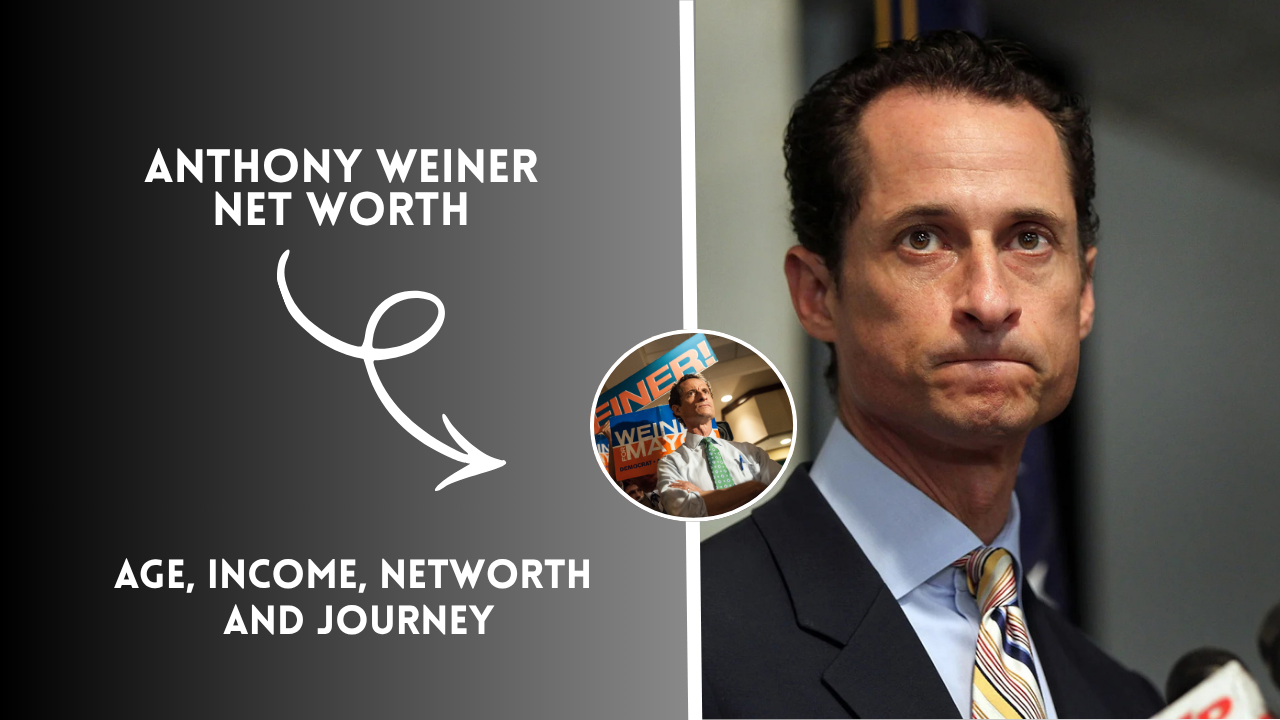

From rising political star to federal convict , Anthony Weiner’s story is one of the most dramatic falls in modern American politics. Once a seven-term congressman with a bright future, his financial world collapsed just as fast as his reputation. Understanding Anthony Weiner Net Worth in 2026 tells us far more than just a dollar figure , it reflects the real cost of public scandal, legal fees, and a career dismantled overnight.
Anthony Weiner Net Worth in 2026 stands at an estimated $350,000, a fraction of what he once earned as a sitting U.S. Representative. His wealth story is not just about money , it is about consequence, resilience, and the long road of financial and personal recovery. The numbers behind his net worth and financial status paint a picture that every political observer and curious reader deserves to know.
Anthony Weiner Bio/Wiki
Anthony Weiner was born on September 4, 1964, in Brooklyn, New York City. He served as a U.S. Representative for New York’s 9th congressional district from 1999 to 2011. He was married to Huma Abedin, a senior aide to Hillary Clinton, and together they have one son. His career ended in a sexting scandal in 2011, and in 2017 he pleaded guilty to transferring obscene material to a minor, serving a 21-month prison sentence.
| Detail | Info |
| Full Name | Anthony David Weiner |
| Date of Birth | September 4, 1964 |
| Birthplace | Brooklyn, New York City |
| Education | SUNY Plattsburgh – B.A. Political Science |
| Occupation | Former Politician, Consultant |
| Spouse | Huma Abedin (divorced) |
| Net Worth (2026) | ~$350,000 |
| Party | Democratic |
| Prison Sentence | 21 months (2017 conviction) |
Key Takeaways
Understanding Anthony Weiner Net Worth matters because it shows how a high-earning public official can face near-total financial collapse. At his congressional peak, Weiner earned a $174,000 annual salary as a U.S. Representative. Legal fees, loss of income, and reputational damage from multiple sexting scandals slashed his wealth dramatically over the years.
By 2026, his estimated financial standing sits at roughly $350,000. He currently earns through consulting, public speaking engagements, and media appearances. His case remains one of the clearest examples in recent American politics of how personal misconduct directly destroys both a career and financial security.
Anthony Weiner Early Life and Background
Anthony Weiner grew up in a middle-class Brooklyn neighborhood, born into a family that valued education. His father worked as a high school math teacher, and his mother practiced as a lawyer , two professional influences that clearly shaped his drive and ambition. He attended PS 39 The Henry Bristow School during his early years and later moved on to Brooklyn Technical High School, where he graduated with distinction.
He grew up alongside two brothers, and family life was grounded and relatively stable. Tragically, his older brother Seth Weiner passed away in 2000, a personal loss that affected the family deeply. His Brooklyn roots and working-class values stayed with him through his political career, shaping his focus on middle-class issues and domestic policy reform.
Educational Journey
After completing high school at Brooklyn Technical High School, Anthony Weiner pursued higher education at the State University of New York at Plattsburgh. He earned a Bachelor of Arts degree in Political Science in 1985, a field that aligned perfectly with his growing interest in public service and civic engagement.
| School | Level | Year |
| PS 39 Henry Bristow School | Elementary | Early years |
| Brooklyn Technical High School | High School | Graduated early 1980s |
| SUNY Plattsburgh | Bachelor’s Degree | 1985 |
His political science major gave him the academic foundation to enter congressional work directly after graduation. He never pursued a law degree or advanced studies , his real education came through hands-on political experience with Charles Schumer’s congressional staff.
Anthony Weiner Physical Appearance
Anthony Weiner stands at approximately 5 feet 11 inches tall with a lean build. He has dark hair and sharp facial features that made him a recognizable presence in the U.S. House chamber and on television news programs. His confident, assertive body language matched his famously combative and passionate debating style in Congress.
| Feature | Details |
| Height | 5 ft 11 in (approx.) |
| Build | Lean and medium frame |
| Hair | Dark brown |
| Eyes | Brown |
| Known Style | Business suits, public speaking attire |
His physical presence and high-energy communication style made him a frequent cable news guest during his congressional years. Even after his political downfall, he remained recognizable in public settings across New York City.
Entry Into Politics
Anthony Weiner entered politics at just 21 years old, jumping into the world of public service immediately after graduating from SUNY Plattsburgh. He joined the staff of U.S. Representative Charles Schumer in 1985, working directly in Schumer’s Brooklyn district office. That early entry set the foundation for what would become a remarkable , and ultimately troubled , political career.
His ability to connect with constituents and understand local community needs impressed Schumer’s team quickly. By 1991, Weiner had built enough of a political base to run for the New York City Council, where he became the youngest member ever elected at just 27 years of age , a major milestone that signaled a powerful political future.
Early Political Start
Weiner’s early political start proved just how focused and driven he was. After years as a Schumer staff member, he entered the New York City Council in 1991, representing a Brooklyn-Queens district. He quickly earned a reputation for aggressively advocating for his constituents and taking on issues that other politicians avoided.
By 1998, he successfully ran for and won a seat in the U.S. House of Representatives, replacing his mentor Charles Schumer who had moved to the Senate. His victory marked the beginning of seven consecutive terms in Congress, where he consistently pushed for healthcare reform, middle-class tax relief, and domestic social policy improvements.
Schumer’s Staff Influence
Working under Charles Schumer from 1985 to 1991 profoundly shaped Weiner’s entire political worldview. Schumer’s Brooklyn-focused approach to constituent service , solving real problems for real people , became the model Weiner applied throughout his own career.
| Year | Milestone |
| 1985 | Joined Schumer’s congressional staff |
| 1991 | Elected to NYC Council (youngest member) |
| 1998 | Elected to U.S. House of Representatives |
| 2011 | Resigned amid sexting scandal |
Schumer’s mentorship and influence taught Weiner how to combine media savvy with grassroots political organizing , a combination that fueled his rise and made him one of Brooklyn’s most visible political voices for over two decades.
Congressional Career
Anthony Weiner served seven terms in Congress representing New York’s 9th congressional district from 1999 to 2011. During that time, he earned a reputation as one of the most outspoken and passionate voices in the Democratic Party. His floor speeches were fiery, direct, and often went viral before “going viral” was even a common phrase.
He focused his legislative energy on healthcare reform, affordable housing, and economic security for working families. He secured his last electoral win in 2010 with 60.8% of the vote, showing that despite his often abrasive style, voters in his district remained strongly supportive. His congressional salary of $174,000 annually contributed significantly to his earlier, healthier financial standing.
Key Legislative Initiatives
Weiner’s legislative record in Congress was substantial. He co-founded the bipartisan Congressional Middle Class Caucus, championed Medicare expansion, and consistently voted to protect women’s reproductive rights. These initiatives reflected his core belief that government should actively protect and support working-class and middle-class Americans.
His efforts around healthcare legislation were particularly notable. He strongly pushed for a public option in healthcare reform debates, making passionate floor speeches that drew national media attention. His legislative style was direct and unapologetic , qualities that earned him both fierce allies and powerful enemies within the political establishment.
Middle Class Caucus
The Congressional Middle Class Caucus, which Weiner co-founded alongside other Democratic lawmakers, became one of his most enduring legislative achievements. The caucus focused on addressing everyday financial pressures that middle-class families faced , from rising healthcare costs to stagnant wages and affordable housing shortages.
| Caucus Focus Area | Legislative Goal |
| Healthcare Reform | Lower medical costs for families |
| Affordable Housing | Increase access to housing programs |
| Economic Opportunity | Support job security and wage growth |
| Middle-Class Tax Relief | Reduce tax burden on working families |
The caucus attracted bipartisan support at various points, reflecting Weiner’s ability to reach across political lines when the issue genuinely served working Americans.
Medicare Expansion Efforts
Weiner was one of Congress’s loudest advocates for expanding Medicare access to more Americans. He pushed hard for lower prescription drug prices, better access for underserved communities, and the elimination of coverage gaps that left millions of middle-class families financially vulnerable during medical emergencies.
His healthcare reform advocacy extended beyond Medicare. He vocally supported a single-payer health system and consistently voted against legislation that would cut benefits or restrict eligibility. These efforts earned him strong support from progressive voter blocs and healthcare advocacy organizations throughout his congressional tenure.
Pro-choice Advocacy
Weiner was an unwavering pro-choice advocate throughout his political career. He co-sponsored the Women’s Health Protection Act, supported expanded access to contraceptives, and actively fought against state-level legislation that restricted abortion access across the country.
He supported increased federal funding for Planned Parenthood and consistently voted against any measure that would reduce reproductive healthcare services. His pro-choice voting record was considered one of the strongest in the House at the time, making him a reliable ally for women’s rights organizations and advocacy groups focused on reproductive health policy.
First Major Scandal
In May 2011, Anthony Weiner’s political career came crashing down when he accidentally posted a sexually explicit photo on his public Twitter account. The incident sparked an immediate media frenzy and launched a prolonged public scandal. Weiner initially denied sending the image and claimed his account had been hacked , a claim that quickly fell apart under scrutiny.
As more explicit photos and messages surfaced, Weiner admitted to the truth. He had been sending inappropriate messages and images to multiple women online. Facing enormous political pressure from his own party’s leadership, he resigned from the U.S. House of Representatives on June 16, 2011, ending his seven-term congressional career in disgrace.
Subsequent Controversies
The 2011 scandal was not the end. In 2013, during his New York City mayoral campaign, additional sexting messages surfaced , sent under the alias “Carlos Danger” , further destroying his political rehabilitation efforts. Then, in 2016, federal investigators found sexting communications with a 15-year-old girl on his devices during an unrelated investigation into his estranged wife Huma Abedin’s emails.
In 2017, Weiner pleaded guilty to transferring obscene material to a minor and received a 21-month federal prison sentence. He served his sentence and was released. These cascading controversies devastated his public image, his marriage, and his financial standing, slashing his wealth from millions to an estimated $350,000.
Anthony Weiner Fun Facts
- He became the youngest NYC Council member in history at age 27.
- He appeared in a 2016 documentary simply called “Weiner”, which won the U.S. Documentary Grand Jury Prize at Sundance Film Festival.
- He was once considered a frontrunner to become Mayor of New York City.
- His wife Huma Abedin filed for divorce after his 2016 scandal.
- He served under Charles Schumer for six years before his own political career took off.
Anthony Weiner Hobbies
Outside of politics, Weiner was known to enjoy basketball, reading political history, and following New York sports teams closely. He reportedly enjoyed running as a form of stress relief and stayed physically active during his congressional years. He also had a well-documented passion for political debate , not just professionally but in social settings as well.
Impact on Political Career
The sexting scandals didn’t just end Anthony Weiner’s congressional career , they permanently closed the door on any future in electoral politics. His resignation in 2011 stripped him of his $174,000 congressional salary overnight. His failed 2013 mayoral run and the subsequent federal conviction in 2017 erased whatever remained of his political credibility.
His story serves as a case study in how personal conduct, even in private digital communications, can completely overrule a politician’s policy record and public service history. The scandals also triggered costly legal proceedings, defense attorney fees, and settlements that directly contributed to the decline of his financial position over the following years.
Mayoral Campaign Attempts
Weiner attempted a political comeback in 2013 by running for Mayor of New York City. He launched his campaign with surprising early momentum , initial polls actually placed him in first place among Democratic primary candidates, suggesting voters were willing to give him a second chance if he focused on real policy issues.
However, the emergence of new sexting messages under the “Carlos Danger” alias in July 2013 derailed the campaign completely. He finished a distant fifth in the Democratic primary, capturing only about 4.9% of the vote. Bill de Blasio went on to win the mayoral race. The 2013 campaign failure confirmed that Weiner’s path back to elected office was effectively closed.
Campaign Challenges Faced
| Campaign Stage | Event |
| Early Polling | Led Democratic primary polls |
| July 2013 | New sexting messages surfaced |
| Poll Decline | Support collapsed rapidly |
| Primary Result | Finished 5th with ~4.9% of votes |
His campaign faced an impossible combination of media scrutiny, public distrust, and political opposition that no policy platform could overcome. Voters who were initially willing to forgive the 2011 incident drew a firm line when additional messages appeared.
Public Reactions Explored
Public reaction to Weiner’s mayoral campaign was deeply divided. Many New Yorkers felt genuine sympathy for his policy platform, which addressed real issues like income inequality and housing affordability. Others viewed his campaign as a cynical attempt to recapture personal power rather than genuinely serve the public.
The 2016 documentary “Weiner” captured the raw reality of his campaign implosion in real time, showing how public trust, once broken by scandal, becomes nearly impossible to rebuild in a high-stakes electoral environment. The film became a critical success and a cautionary tale about the intersection of personal behavior and public life.
Transition to Private Sector
After leaving Congress in 2011, Weiner had to completely reinvent his professional identity. With no elected position and a damaged reputation, he turned toward the private sector , exploring consulting work, media appearances, and digital marketing ventures as ways to maintain income and stay professionally relevant.
His transition was far from smooth. Most traditional corporate employers and lobbying firms avoided association with him due to the reputational risk. He relied heavily on his political expertise and media name recognition to carve out a niche in consulting and public speaking, where his controversial profile sometimes worked in his favor by generating audience interest.
Sources of Income Post-Congress
After his congressional career ended, Anthony Weiner Net Worth relied on a small but diverse set of income streams. He pursued consulting projects focused on political strategy, accepted paid speaking engagements, made media appearances, and dabbled in digital marketing ventures. None of these matched his former congressional salary in consistency or volume.
His financial recovery has been slow and partial. Legal fees from both his 2011 resignation fallout and his 2017 federal conviction drained substantial savings. The estimated $350,000 net worth in 2026 reflects years of reduced earning power combined with unavoidable legal and personal expenses that came with his very public downfall.
Consulting and Speaking Engagements
Weiner’s primary post-congressional income comes from political consulting and public speaking. He offers strategic advice to clients on political positioning, media relations, and public communications , areas where his extensive firsthand experience gives him genuine credibility despite his personal controversies.
| Income Source | Description |
| Political Consulting | Strategy advice for campaigns and firms |
| Public Speaking | Paid talks on politics and personal experience |
| Media Commentary | Guest appearances on news and talk programs |
| Digital Marketing | Consulting for small business clients |
Speaking fees vary widely, but his notoriety often works as a draw for events focused on media ethics, political accountability, and crisis communications , topics where his personal experience provides undeniable firsthand perspective.
Media Appearances Revenue
The 2016 documentary “Weiner” brought renewed public attention and opened doors to media appearance opportunities. He appeared on various talk shows and news programs, discussing politics, personal accountability, and public life. These appearances generated income while keeping his public profile active.
His media revenue is not steady or substantial, but it supplements his consulting income meaningfully. The documentary itself became a Sundance Film Festival winner, boosting its commercial profile and extending Weiner’s media relevance beyond the immediate scandal news cycle.
Digital Marketing Ventures
Weiner also pursued digital marketing consulting as part of his post-congressional income strategy. He applied his political communication experience to help small business clients build online presence, messaging strategy, and audience engagement through digital platforms.
He has also explored educational content through webinars and workshops, sharing insights on political communication and public messaging. While these ventures haven’t produced dramatic income, they represent a practical effort to convert his political knowledge into marketable professional skills in the private sector.
Real Estate and Assets
Anthony Weiner owns a residential property in New York City, which remains his most significant tangible asset. Real estate in New York, even in modest neighborhoods, holds considerable value , and his property contributes meaningfully to his overall financial standing in 2026.
| Asset Type | Description | Financial Impact |
| NYC Residence | Home in New York City | Significant |
| Real Estate Holdings | Investment properties | Moderate |
| Business Ventures | Digital marketing projects | Incremental |
| Personal Vehicles | Cars and personal property | Additional |
| Collectibles/Valuables | Personal possessions | Minor |
Beyond real estate, his personal assets include vehicles and personal valuables. His overall asset profile is modest compared to former colleagues in Congress, many of whom built significant investment portfolios during and after their political careers.
Financial Challenges and Recovery
Anthony Weiner Net Worth suffered most dramatically from the combination of lost congressional salary, massive legal fees, and the near-total collapse of his earning potential in high-income professional fields. From 2011 onward, each scandal triggered new financial strain.
His 2017 federal conviction and 21-month prison sentence effectively paused his ability to earn for nearly two years. After release, he rebuilt slowly through consulting and speaking work, but the financial damage from legal proceedings and reputation loss has proven difficult to fully reverse. His current $350,000 estimated worth reflects resilience , but also the lasting financial consequences of his actions.
Current Professional Endeavors
As of 2026, Weiner focuses his professional energy on political consulting, media commentary, and small business advising. He applies his decades of political experience and media knowledge to clients who value his firsthand insights into crisis communication and public affairs management.
He remains active in digital media spaces and occasionally accepts speaking invitations where his controversial career history is itself a draw. His current professional endeavors are modest by congressional-career standards but represent a genuine effort to maintain professional relevance and financial stability after one of the most public falls from grace in modern American political history.
Long-term Financial Outlook
The long-term financial outlook for Anthony Weiner depends heavily on his ability to expand consulting and speaking income while managing his public image carefully. His projected $350,000 net worth through 2026 reflects stability rather than growth , a baseline he has maintained through disciplined financial management.
Future income growth depends on whether the media and consulting markets continue to find value in his political expertise and personal story. If he successfully repositions himself as a voice on political accountability and ethical governance, there is a reasonable path toward slowly improving his financial position over the next five to ten years.
Anthony Weiner Future Plan and Goals
Weiner’s stated goals center on professional rehabilitation, income diversification, and maintaining a stable personal life following his release from federal prison. He has expressed interest in contributing to political commentary and potentially writing a memoir that addresses his rise, fall, and personal transformation.
His future financial strategy appears to rely on building consulting revenue, expanding his media presence, and pursuing educational ventures that monetize his political experience. Whether the public appetite for his story translates into meaningful income growth remains the central question shaping Anthony Weiner Net Worth in the years ahead.
Most Asked Questions
How much is Anthony Weiner worth in 2026? Anthony Weiner Net Worth in 2026 is estimated at approximately $350,000, reduced significantly by legal fees and lost congressional income.
Why did Anthony Weiner go to prison? He pleaded guilty in 2017 to sending obscene material to a minor and served a 21-month federal prison sentence, which severely impacted Anthony Weiner Net Worth.
What does Anthony Weiner do for money now? Anthony Weiner Net Worth is supported through consulting, public speaking, and media appearances that utilize his political experience and public profile.
How much did Anthony Weiner earn as a congressman? As a U.S. Representative, Anthony Weiner Net Worth was supported by an annual congressional salary of $174,000 across his seven terms in office.
Was Anthony Weiner married to Huma Abedin? Yes, Anthony Weiner was married to Huma Abedin; they separated after his 2016 scandal, and the divorce finalized , contributing to personal and financial strain on Anthony Weiner Net Worth.
Conclusion
Anthony Weiner’s story is a powerful reminder that talent and political achievement alone cannot protect a person from the consequences of their own choices. Anthony Weiner Net Worth in 2026, sitting at roughly $350,000, tells the full story of what happens when scandal, legal proceedings, and reputational damage collide with a once-promising career. From a Brooklyn middle-class upbringing to Congress and back to private life, his financial journey reflects both the cost of misconduct and the difficult, ongoing work of personal and professional recovery. Anthony Weiner Net Worth may never return to its congressional-era peak , but his story remains one of the most instructive in modern American political life.